

On this page
Here is a moment I see, in some form, in almost every discovery call.
Someone shares their screen to show me how the team uses AI, and it is genuinely good. A tool reads incoming purchase orders (emails, PDFs, the occasional phone photo) and pulls out every line item correctly. Then I ask what happens next. The answer is nearly always a version of: "Then someone types it into the system."
The AI does the clever part. A person still does the tedious part. The process looks exactly as it did before, with one extra step added.
That business uses AI. It would tick "yes" on any survey. And that, to me, is the real story heading into 2027: most companies have adopted AI, but very few have changed how work actually gets done.
The gap between using AI and getting paid for it
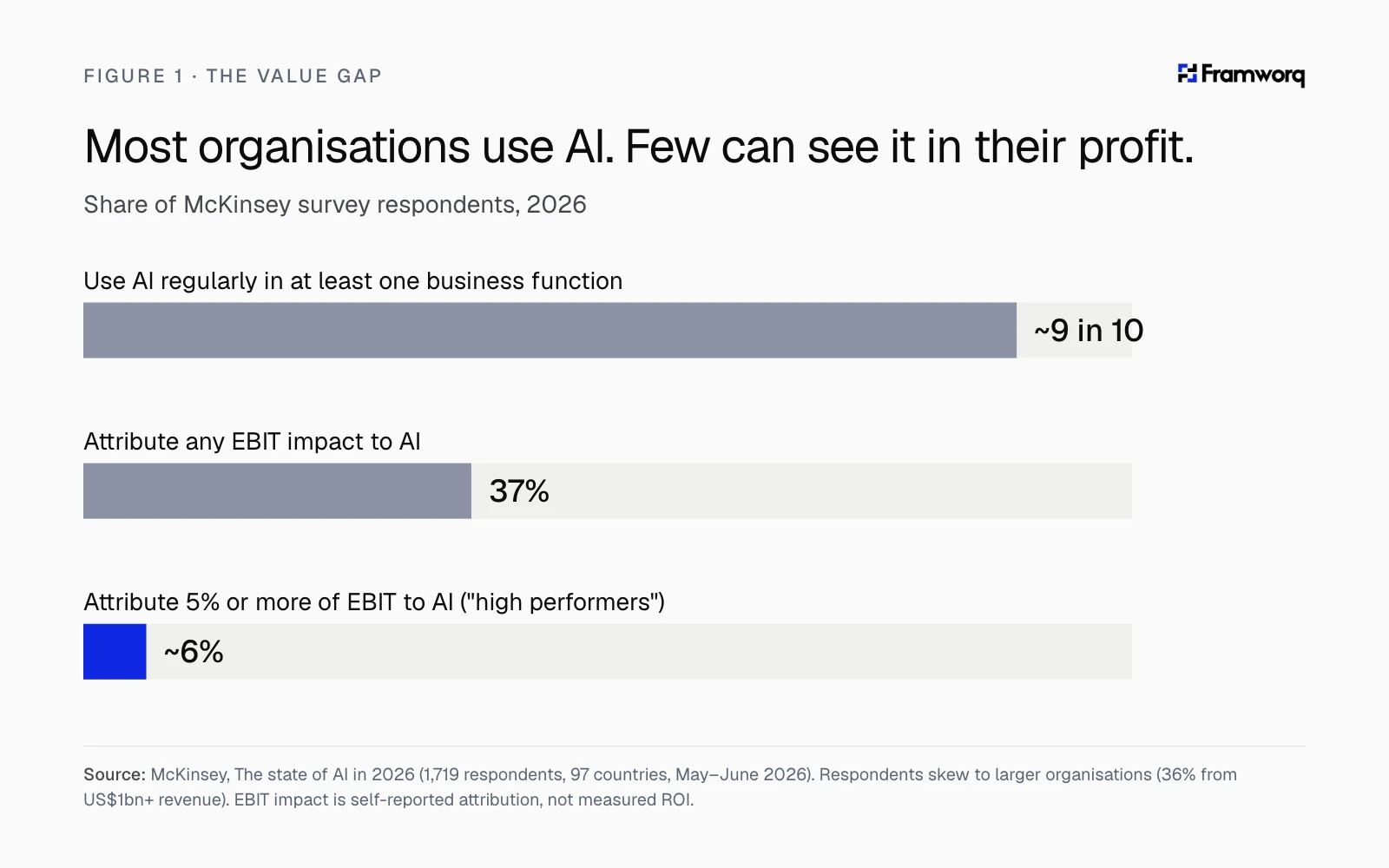
The research points the same way. In McKinsey's 2026 State of AI survey, nearly nine in ten responding organisations said they use AI regularly in at least one business function. Only 37% could attribute any impact on EBIT to it, and around 6% attribute 5% or more.
Two caveats matter. McKinsey's respondents lean toward larger companies; across all businesses, official statistics from the EU and the US put AI use closer to one firm in five. And "EBIT impact" is the respondents' own attribution, not audited ROI. Even so, the direction is hard to argue with.
Why 2027 is different
Three shifts make me think 2027 is the year this gap stops being tolerable.
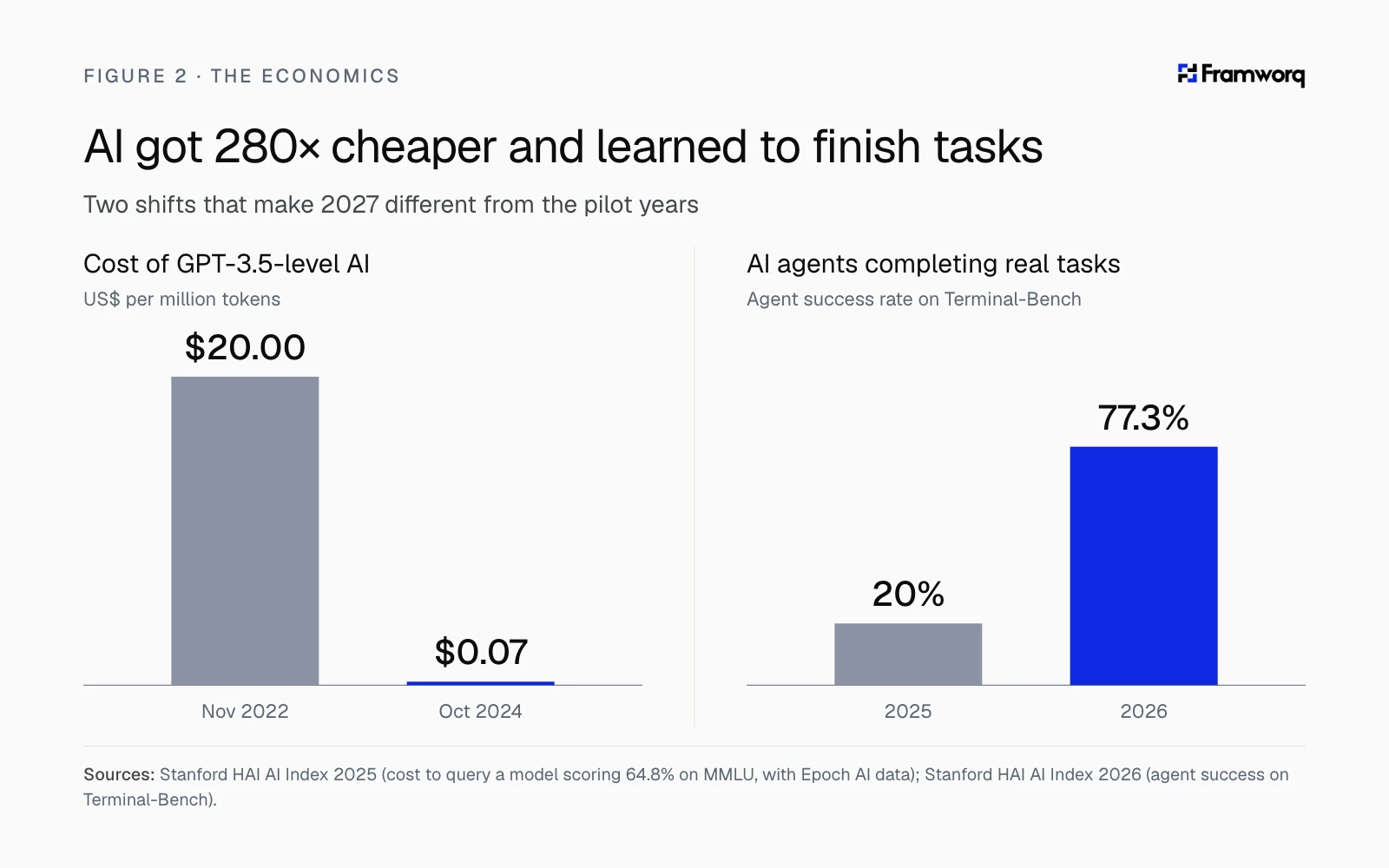
Intelligence got cheap. Stanford's AI Index found the cost of running a model at GPT-3.5 level fell more than 280-fold between late 2022 and late 2024. My takeaway: when the model costs almost nothing, the model stops being the advantage. Most businesses rent the same few models. What is left to compete on is the plumbing: how well AI connects to your CRM, your inbox, your ERP and your rules for handling exceptions. In the projects I scope, the model is rarely the expensive part. Connecting it to everything else is.
AI can now finish tasks, not just draft them. Stanford's 2026 AI Index reports AI agents' success on Terminal-Bench, a benchmark of real multi-step computer tasks, rising from 20% to 77.3% in a single year. In 2024, AI could draft a reply to a customer. Today an AI agent can read the enquiry, check the calendar, book the slot and update the CRM, while a person approves the step that matters.
Agents are arriving inside the software you already pay for. Your CRM, helpdesk and e-commerce platform are shipping their own agents; Gartner expects up to 40% of enterprise applications to include task-specific agents by 2026. You will not need to go looking for AI in 2027. The question becomes whether your processes and data let those agents do anything useful.
There is a counterweight. Gartner also predicts that more than 40% of agentic AI projects will be cancelled by the end of 2027, citing rising costs, unclear business value and weak risk controls. So 2027 is the year agents arrive, and also the year of the shakeout. Which side a business ends up on will depend less on the tool and more on the approach.
Why businesses automate tasks instead of processes
If the opportunity is in whole processes, why does almost everyone start with single tasks? From what I see, there are three reasons.
Tasks have owners; processes don't. A task sits with one person who feels the pain and can buy a tool to fix it. A process runs across three people, two departments and four systems. Nobody owns all of it, so nobody can fix all of it.
Tools are sold by the task. Every demo shows one impressive step: the summary, the extraction, the drafted reply. Nobody demos the handoff, because the handoff is different in every business.
The value leaks at the handoffs. A chatbot answers questions but cannot check stock, which is the practical difference between an AI chatbot and an AI agent. A purchase order is read perfectly, then keyed into the ERP by hand. A meeting summary lands in an inbox and nobody acts on it. Each tool works; the process around it doesn't move.
When I map a process with a client, I ask one question early on: where does someone copy something from one screen to another? That is usually where the money is. McKinsey's data backs this up: among the organisations getting the most from AI, nearly three-quarters have fundamentally redesigned workflows, compared with about a quarter of everyone else. That is the difference between adding a tool and automating the business process around it.
The cost of doing nothing
Most automation business cases compare the cost of building against the time saved. That misses the bigger number: what the current process costs you without ever appearing on a report.
The enquiry answered the next morning, after the customer has already booked elsewhere. The quote that goes out three days late. The rework when a figure is keyed in wrong. The growth you turn down because hiring takes months. The good employee who leaves because half their week is data entry. None of these show up as a line item, so they get treated as zero. They aren't. We wrote more on the hidden cost of manual processes, and our automation ROI calculator puts a rough number on yours in a couple of minutes.
Why smaller companies can move faster
Large companies are pulling ahead on scaling AI agents. McKinsey's 2026 data shows the share of US$1bn+ organisations doing so rising from 27% to 40% in a year, while smaller organisations stayed flat at 22%. I read that as an execution gap more than an access gap. Smaller businesses can now access many of the same AI models and automation platforms as large enterprises, often without the infrastructure investment that would have been necessary just a few years ago.
Large companies have budget. Smaller companies have something more useful for this kind of work: proximity. The owner is often in the room. One person can describe the whole process from start to finish. There are fewer systems to connect and fewer committees to convince. A 40-person company can redesign how it handles orders in weeks; a 40,000-person company needs a programme.
The opportunity map: where to invest in 2027
This is the framework we use at Framworq to decide where a business should start. It plots each workflow by business value against how ready it is today.
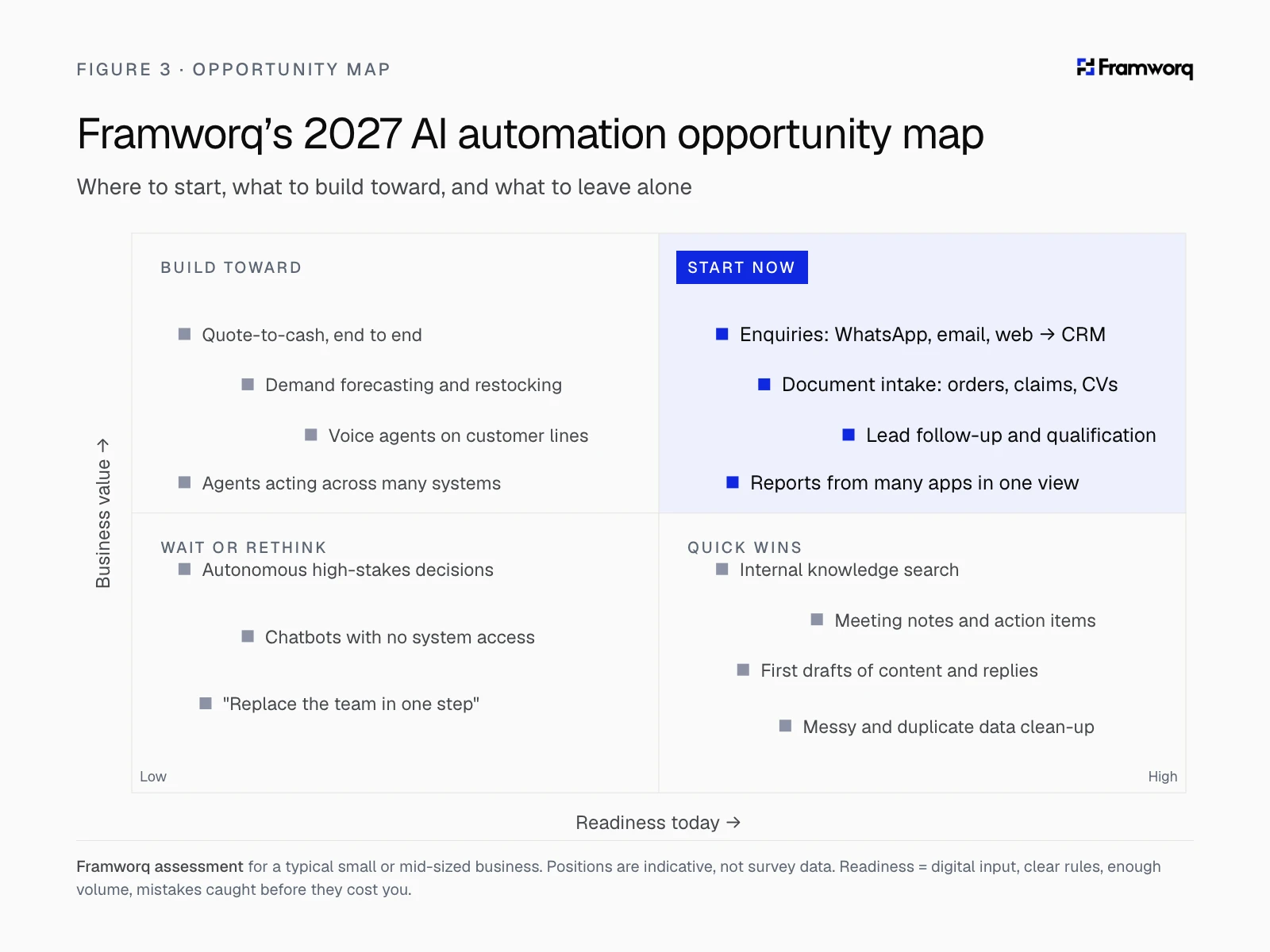
Readiness comes down to four questions (there is a longer guide on how to spot workflows worth automating):
- Is the input already digital? Messages, forms, emails and PDFs are ready. Paper and memory are not.
- Are the rules mostly clear? If two experienced employees would handle a case the same way, the process is usually a stronger candidate for automation.
- Is there enough volume? Ten cases a month rarely justify a build. Ten a day usually do.
- Can a mistake be caught before it costs you? Start where a person can review the output before it reaches a customer or the books.
Start now is deliberately unglamorous: enquiry handling across WhatsApp, email and web forms; document intake for orders, claims and applications; lead follow-up that never forgets; reports that pull data from several apps into one view. These work across industries: clinics, property agencies, distributors, recruiters, retailers and professional firms alike, and they connect directly to revenue and response time.
Build toward holds the ambitious ideas: quote-to-cash run end to end, demand forecasting, voice agents and agents working across many systems. The value is real, but they depend on clean data and connected systems. For most businesses, 2027 is the year to lay that foundation, not to launch them.
The two mistakes I see most often sit in the other corners. Some businesses start top-left, with the impressive end-to-end vision that isn't ready yet, and stall before it delivers anything. Others stay bottom-right indefinitely, with meeting summaries and drafting tools that feel productive but never change how the business runs. Wait or rethink is for anything that removes human review where mistakes are expensive, chatbots with no access to your systems, and any pitch to "replace the team in one step."
The next 12 months
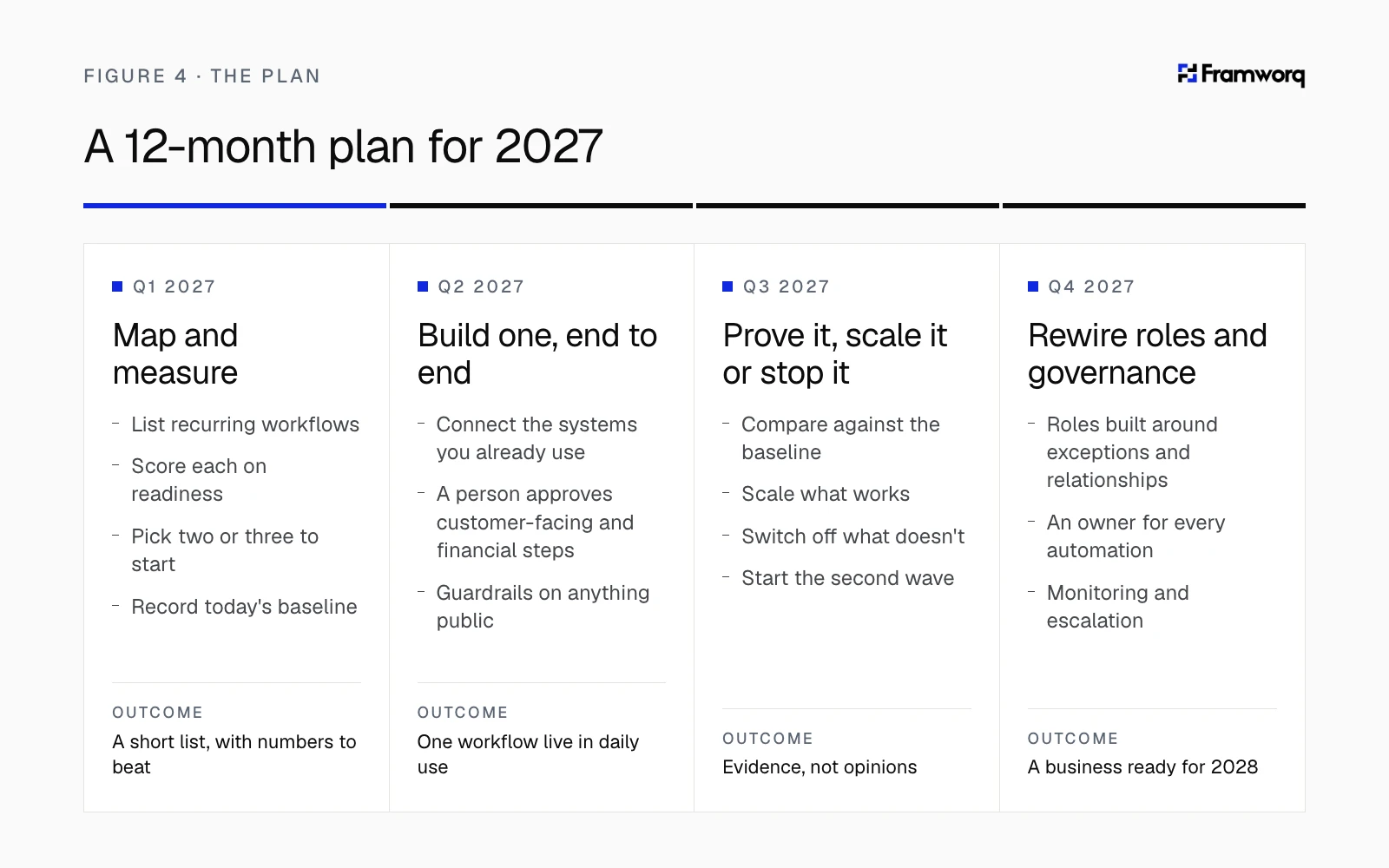
Q1: Map and measure. List your recurring workflows, score them against the four questions, pick two or three from the start-now corner and record today's baseline: time per case, error rate, response time.
Q2: Build one workflow end to end. Connect it to the systems you already use, so nobody copies data between screens. Keep a person approving anything customer-facing or financial at first.
Q3: Prove it, then scale it or stop it. Compare against the baseline. Expand what works and switch off what doesn't. Without a baseline, it becomes difficult to demonstrate whether an AI project is delivering enough value to justify further investment.
Q4: Rewire roles and governance. Shift people toward exceptions, judgement and relationships. Give every automation an owner, monitoring and a way to escalate. Done well, AI automation removes the busywork, not the team.
One lesson from experience: any AI that talks to the public will be tested by strangers. A WhatsApp assistant or website bot will receive messages designed to make it ignore its instructions, leak information or promise things it shouldn't. Build in the guardrails from day one: limit what it can see and do, check what comes in and what goes out, and keep a way to pause it.
The question for 2027
Using AI is no longer the advantage. Almost everyone does. The advantage belongs to businesses that change how the work flows around it.
So the question I would ask going into 2027 is simple: which of your workflows will still depend on someone copying data between two screens in December 2027, and is that a choice you made, or one you defaulted into?
If you're not sure where your own workflows sit, that is exactly what a discovery session is for. We map them with you, then show you where to start.