

On this page
Most automation projects don't stall because the technology is hard. They stall because teams pick the wrong thing to automate first — something rare, low-impact, or so messy it should have been fixed before a bot ever touched it. Here's a simple way to choose well.
Start with frequency × friction
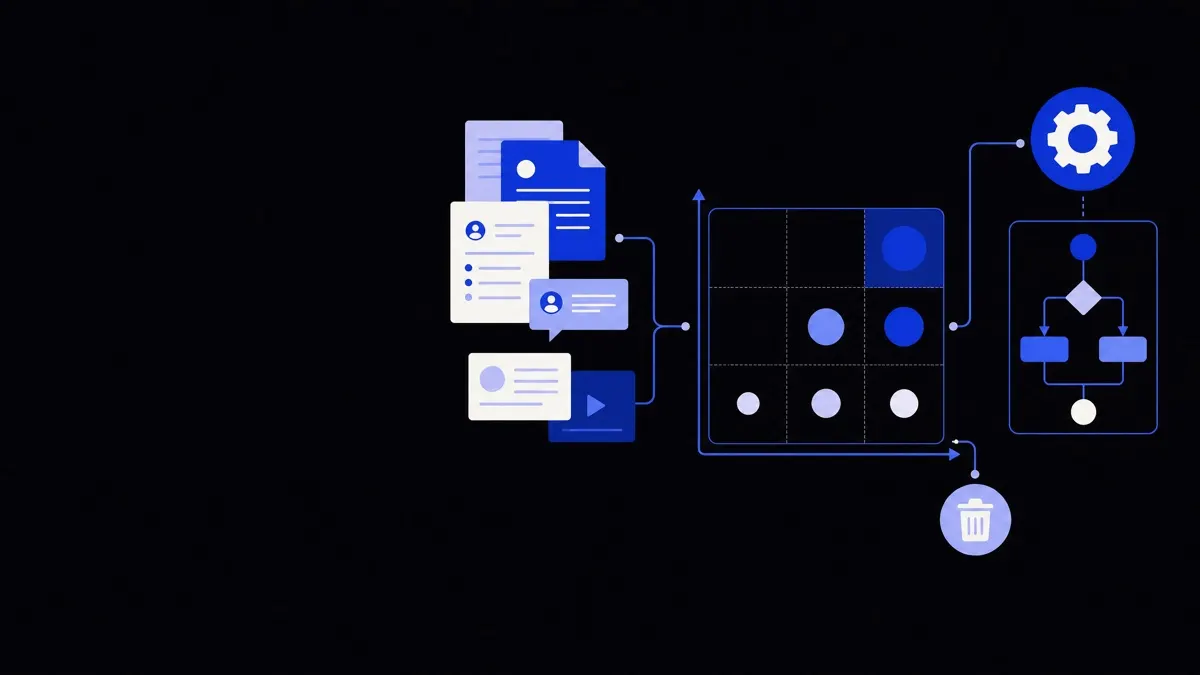
The best first candidates for automation share two traits: they happen often, and each time they happen they create friction — manual effort, delay, errors, or context-switching. Multiply the two and you get a rough measure of how much pain a workflow is quietly costing you.
A task that happens fifty times a day but takes ten seconds isn't worth much. Neither is a painful task that happens twice a year. The workflows worth automating first sit in the top-right corner: high frequency and high friction.
Rule of thumb: if a person does it more than a few times a day, and they sigh a little every time, it belongs on your shortlist.
Four signals a workflow is ready
Beyond frequency and friction, look for these signals that a workflow will automate cleanly rather than fighting you:
- The rules are explicit. You can describe how the task is done in a handful of clear steps, without "it depends" every other line.
- The inputs are structured or semi-structured. Form submissions, emails, spreadsheets, and API data are far easier to work with than a drawer of scanned handwriting.
- The outcome is checkable. You can tell quickly whether the automation did the right thing — a record created, a reply sent, a number that reconciles.
- It crosses a boundary. The task moves information between two tools or two people. That handoff is exactly where things get dropped — and where automation pays off most.
Score your workflows in ten minutes
You don't need a spreadsheet with twenty columns. List the ten tasks your team complains about most, and give each a 1–5 score for frequency and a 1–5 score for friction. Multiply them. Anything scoring 15 or above is a strong first candidate; sort the list and start at the top.
This deliberately favours boring, repetitive work over shiny, complex work. That's the point. Early wins should be obvious, measurable, and low-risk — they build the trust and momentum you'll need for the harder projects later.
What not to automate first
Two categories are tempting but usually wrong for a first project:
- Broken processes. If a workflow is a mess for humans, automating it just makes the mess faster. Fix or simplify the process first, then automate the clean version.
- Rare, high-judgement decisions. Work that hinges on nuance, negotiation, or one-off exceptions is better supported by AI than fully handed to it. Keep a human in the loop.
A simple way to start this week
Pick the single highest-scoring workflow from your list and map it end to end: the trigger that kicks it off, every step in the middle, and what "done" looks like. That map is 80% of the work — once a process is written down clearly, automating it is mostly plumbing.
Then automate just that one workflow, measure the time it gives back, and use the result to decide what's next. Small, proven, compounding — that's how automation actually sticks.