

On this page
The live chat vs AI chatbot decision comes down to when your customers need human nuance and when automation can offer faster, consistent answers at scale. For most teams, the right answer is a hybrid setup where a chatbot handles predictable requests, while live agents step in for complex, emotional, or high‑value conversations.
What is the difference between live chat and an AI chatbot?
Live chat is a real‑time messaging channel where customers talk directly to human agents through your website or app. An AI chatbot is software that uses rules or AI models to respond to customer messages automatically, often 24/7.
The key difference is who answers and how:
- Live chat
- Agent responds in real time.
- Great for complex, nuanced questions.
- Limited by staff schedules and capacity.
- AI chatbot
- System responds automatically.
- Great for repeatable, well‑defined tasks.
- Scales to many conversations at once.
In practice, many companies combine both. A chatbot handles the initial triage and common requests, then hands over to live chat when needed.
Use automation to handle what is predictable, and human support to handle what is important but unpredictable.
Pros and cons of live chat
Live chat is often the first upgrade from email support because it feels personal and immediate. It also comes with clear trade‑offs.
Advantages of live chat
- Human empathy and nuance
A human can read context, adjust tone, and handle sensitive topics like billing disputes, complaints, or health‑related questions in ways that build trust.
- Flexible problem‑solving
Agents can improvise, ask follow‑up questions, and handle edge cases that are not in any script or help article.
- Higher confidence for complex issues
Customers often feel more reassured when a person confirms they have understood the situation and will take action.
- Upsell and relationship building
Skilled agents can spot buying signals, suggest better options, and deepen the relationship in a way scripted interactions rarely match.
Limitations of live chat
- Limited availability
Support hours usually mirror staff working hours. Outside those times, customers wait or fall back to email or forms.
- Scaling costs rise with volume
Each additional concurrent chat requires more agent capacity. As chat volume grows, you hire more people or increase wait times.
- Inconsistent answers
Different agents may give slightly different responses, especially if documentation is incomplete or outdated.
- Agent fatigue and burnout
Handling many conversations in real time can be stressful. Quality often drops under peak loads or when staff is stretched thin.
Live chat works best when you need high‑quality human conversations and your volume is manageable with your current or planned team size.
Pros and cons of AI chatbots
AI chatbots range from simple scripted bots to advanced systems powered by large language models. Their strengths and weaknesses depend on your data, design, and monitoring.
Advantages of AI chatbots
- 24/7 availability
Bots can respond at any hour, which is especially valuable for global audiences or time‑sensitive issues like order tracking or access problems.
- Instant responses for common tasks
Chatbots are effective at routine requests such as:
- Password resets guidance
- Order or booking status
- Basic troubleshooting steps
- FAQs on pricing, policies, and features
- High concurrency and lower marginal cost
A single chatbot can handle hundreds of conversations at once, which reduces the need to scale agent headcount in lockstep with growth.
- Structured data capture
Bots can consistently collect key details (order ID, product, device, issue category) before a human agent steps in, reducing handling time.
- Consistency and policy compliance
Properly configured bots follow policy every time, reducing the risk of unauthorized promises or discounts.
Limitations of AI chatbots
- Limited empathy and judgment
Even with natural language capabilities, bots can miss emotional cues or fail to recognize when a situation is sensitive or high risk.
- Risk of incorrect or vague answers
AI models can produce plausible but wrong responses if not grounded in accurate knowledge or if guardrails are weak.
- Setup and maintenance effort
To work well, bots need:
- Clear goals and flows
- Access to updated knowledge
- Regular testing and tuning
This is not a one‑time project.
- User frustration if overused
Forcing bots on customers with serious or urgent issues can erode trust, especially if there is no clear path to a human.
Modern platforms, like those used in Framworq’s AI chatbots and voice agents solutions, address many of these issues with better training data, human handoff, and monitoring.
Live chat vs AI chatbot: key factors to guide your choice
Instead of asking “Which tool is better?”, it is more useful to ask “What problems are we trying to solve?” The right answer depends on a few practical factors.
1. Nature and complexity of customer queries
Consider what customers actually ask you, not just what you expect.
- Mostly simple, repetitive questions
If 60–80% of your questions are “Where is my order?”, “What are your opening hours?”, or “How do I reset my password?”, an AI chatbot can safely handle much of the load.
- Frequently complex or high‑stakes questions
If many inquiries involve custom configurations, legal or financial implications, or emotional topics, live chat should remain prominent, with a bot in a supporting role only.
- Predictable vs unpredictable
Predictable flows (returns, appointment booking) map well to bots. Unpredictable issues (integrating multiple systems, unusual account errors) need humans.
2. Volume, response time, and service levels
Look at your current and projected contact volume.
- Low to moderate volume
If your team can respond quickly without queueing, live chat alone can be sufficient, especially for B2B or premium services.
- High or spiky volume
If you struggle with long wait times during campaigns, product launches, or seasonal peaks, a chatbot can absorb the first layer of demand.
- Response time targets
If your customers expect near‑instant replies around the clock, a hybrid model is often the only practical way to meet that consistently.
3. Budget, staffing, and growth plans
Costs show up in different ways for each option.
- Live chat cost profile
- Ongoing salaries, training, and management.
- Costs scale roughly with volume and coverage hours.
- Easier to start, but harder to scale linearly.
- AI chatbot cost profile
- Higher upfront design and setup.
- Lower marginal cost per conversation once running.
- More favorable if you expect steady volume growth.
If you are planning for growth, a chatbot can delay or reduce the need for additional headcount, freeing human agents to focus on higher‑value work.
4. Customer expectations in your industry
Customer tolerance for automation varies.
- Ecommerce and consumer services
Customers are often comfortable with bots for tracking, returns, and FAQs, as long as human help is easily available when needed. See our dedicated focus on AI automation for ecommerce for typical use cases.
- Healthcare, financial services, recruitment, or legal
Customers expect more human contact, especially when disclosing personal or sensitive information. A bot can triage and answer generic questions, but live chat or phone support should remain prominent.
- B2B and high‑ticket products
Buyers often want direct access to knowledgeable humans. Here, bots work well as assistants to the team rather than full front‑line agents.
5. Internal processes and data quality
AI chatbots are only as good as the content and systems they rely on.
- If your knowledge base is incomplete or outdated, a bot will echo those gaps.
- If your internal systems (CRM, order system, scheduling) are fragmented, it becomes harder to automate end‑to‑end tasks.
In such cases, starting with live chat and gradually adding automation as you clean and connect your systems may be more realistic. Tools like custom API integrations can help connect chatbots to your existing stack when you are ready.
When a hybrid live chat + AI chatbot model works best
For many teams, the most effective approach is not choosing one over the other, but designing how they work together.
Common hybrid patterns
- Bot‑first, human‑backed
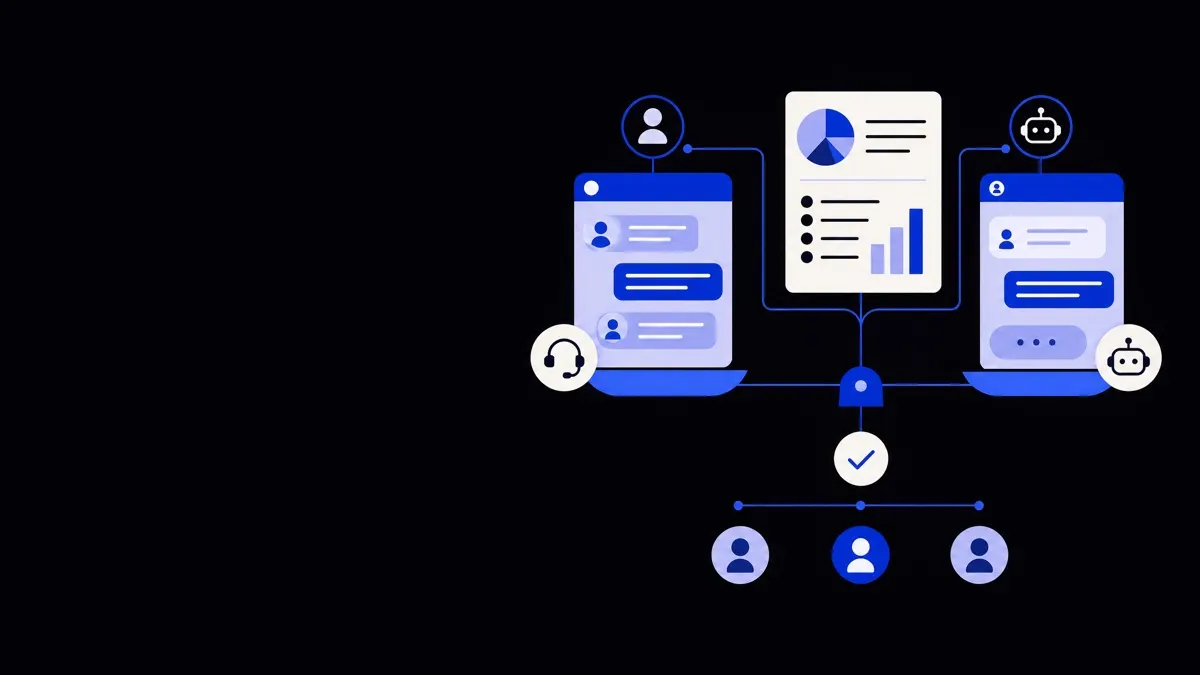
The chatbot greets users, handles simple tasks, and collects details. At any point, or for certain topics, it offers a “Talk to a person” option and passes the context to live chat.
- Human‑first, bot‑assisted
Agents stay primary, while AI suggests responses, retrieves knowledge articles, and drafts replies. The customer never talks directly to the bot, but benefits from its speed behind the scenes.
- Time‑based routing
During business hours, live agents handle more chats directly. Outside hours, the chatbot takes over, offering basic help and capturing issues for follow‑up.
- Intent‑based routing
The bot classifies the customer’s intent. It handles safe, routine topics itself and routes sensitive or complex ones to a human immediately.
Designing a smooth handoff
A good hybrid experience depends on how you manage the transition from bot to human and back.
- Make escalation obvious and respectful
Clearly offer human help rather than hiding it behind multiple bot interactions.
- Pass full context to agents
Include the chat history, collected fields, and any actions taken so far, so customers do not repeat themselves.
- Signal agent identity and role
When a human joins, show their name and clarify they are now in control of the conversation.
- Close the loop
After agents resolve new or unusual issues, consider updating the bot’s knowledge so it can handle similar questions next time.
Teams often partner with agencies like Framworq to design, implement, and refine this hybrid model using AI chatbots and voice agents tailored to their workflows.
How to decide: a simple decision framework
Use these steps to choose your starting point and roadmap.
- Audit your conversation types
- Categorize 100–200 recent chats or emails.
- Tag each as simple, moderate, or complex.
- Note where customers most often express frustration or confusion.
- Define what “success” looks like
- Faster first response?
- Lower handling cost per contact?
- Higher customer satisfaction on specific journeys (onboarding, returns, renewals)?
Be explicit and prioritize.
- Choose your primary channel for the next 6–12 months
- If complexity is high and volume modest → emphasize live chat, add light automation (suggested replies, basic FAQ bot).
- If repetitive volume dominates → lead with an AI chatbot, with clear human escalation paths.
- Design a minimal viable hybrid
- Pick 2–3 journeys to automate first (e.g., order tracking, booking changes, simple product questions).
- Define clear rules for when and how to hand over to live agents.
- Measure, then expand
- Track metrics such as:
- Bot containment rate (issues solved without human)
- Average response and resolution time
- Customer satisfaction or feedback comments
- Use the data to refine content, flows, and routing before automating more journeys.
- Track metrics such as:
- Review governance and training
- For live chat: update training on tone, escalation, and use of AI assistance.
- For chatbots: establish a schedule to review logs, update knowledge, and correct failure patterns.
By treating live chat and AI chatbots as complementary tools rather than opposing choices, you can design a support system that adapts as your products, customers, and team evolve.