

On this page
- What does AI automation competitive advantage actually mean?
- Why AI automation favors small and mid-sized businesses
- Where AI automation creates the most strategic value for SMEs
- How SMEs can position AI automation strategically, not just tactically
- Risks and trade-offs SMEs should understand
- A practical roadmap for SMEs to build AI automation advantage
AI automation competitive advantage comes from using software and machine learning to perform routine knowledge work faster, more consistently, and at lower cost than human-only processes. For small and mid-sized enterprises, this shifts AI from a nice-to-have experiment into a practical way to operate leaner, respond faster to customers, and free people to focus on higher-value work that competitors cannot easily copy.
What does AI automation competitive advantage actually mean?
AI automation is the use of algorithms and models to handle repeatable tasks that previously required human judgment, such as drafting emails, routing support tickets, or checking documents. Competitive advantage is the durable edge one company has over another in cost, speed, quality, or differentiation.
For SMEs, AI automation becomes a competitive advantage when it changes the economics or quality of how you operate in a way that is hard for others to imitate quickly.
In practice, this usually shows up in four areas:
- Lower unit costs – serving more customers or processing more work with the same or smaller team.
- Faster response and cycle times – quotes, support, approvals, and decisions completed in minutes instead of days.
- More consistent quality – fewer errors and rework in processes that used to depend heavily on individual staff.
- Distinctive experiences – service that feels more personal and responsive, even though much of it runs on automation.
The key is not using AI everywhere, but applying it where it directly supports your core strategy.
Why AI automation favors small and mid-sized businesses
Large enterprises have bigger budgets, but SMEs often have an agility advantage. AI automation amplifies this.
1. Lower barriers to experimentation
Modern AI tools are mostly cloud-based and subscription-priced. That means:
- No big upfront license costs or hardware purchases.
- The ability to trial tools in weeks, not months.
- Easier replacement if a tool does not fit.
SMEs can pilot a narrow use case, prove value, and expand gradually. Large corporations often face complex approvals, rigid legacy systems, and slower decision cycles.
2. Leaner operating models
A lean operating model is one where you minimize waste and variability in how work gets done. AI automation supports this by:
- Handling repetitive data entry, copying, and formatting.
- Standardizing routine communications with templates and AI drafting.
- Automating simple approvals and routing based on rules.
This lets you grow revenue without growing headcount at the same rate. Your “people per unit of output” can stay flat while the business scales.
3. Focus on differentiation, not just efficiency
SMEs rarely win by outspending competitors; they win by being more focused or more responsive. AI helps you:
- Gather and summarize customer feedback faster.
- Personalize offers or follow-ups based on behavior.
- Surface patterns from your own data that would otherwise stay hidden.
Instead of burning time on low-value admin, your team can spend more time on relationships, product improvements, and decisions only humans can make.
The real advantage is not AI itself, but how quickly you can turn it into better decisions, faster service, and leaner operations.
Where AI automation creates the most strategic value for SMEs
Not every process is worth automating. The strongest advantages come where AI improves work that touches customers, cash, or core decisions.
Customer support and service
AI can act as a front line and an assistant to your human agents:
- Chatbots and email responders that handle common questions 24×7.
- Automatic triage and routing of tickets to the right person.
- Suggested replies and knowledge articles for agents inside their tools.
This lowers response times and backlog without hiring a large support team. A competitor that still relies on manual triage and long email chains will feel slow and less reliable by comparison.
Sales and marketing operations
AI helps sales and marketing teams do more with limited capacity:
- Lead qualification based on behavior and past data.
- Automated follow-up sequences that stay on-brand but feel personal.
- Drafting proposals, outreach emails, and campaign copy.
When you automate the “follow-through” work, your salespeople can spend more time on conversations that actually move deals. Over time, this compounds into higher win rates and repeat business.
You can see practical patterns for this in sales and marketing automation solutions.
Back-office and operations
Many SMEs run on email threads and spreadsheets. AI automation can stabilize those processes:
- Invoice reading, matching, and basic validation.
- Document classification and data extraction.
- Routine status updates to customers or internal teams.
This reduces errors, avoids duplicated work, and creates clearer visibility into what is happening day to day. A business that can close its books quickly and track work-in-progress accurately can price better and spot issues sooner.
Data and decision support
AI is particularly useful for “sense-making” work:
- Summarizing large sets of customer comments or survey answers.
- Highlighting anomalies in orders, churn, or stock usage.
- Turning raw operational data into simple briefs leadership can act on.
Here, the competitive advantage is faster and more grounded decisions, not just automation for its own sake.
How SMEs can position AI automation strategically, not just tactically
A lot of AI experiments fail because they chase novelty instead of strategy. To make AI automation a lasting edge, connect it directly to how you compete.
1. Start from a business thesis, not from tools
Define in one sentence how you aim to win:
- “We win by being the fastest reliable option in our niche.”
- “We win by offering the most personal, relationship-driven service.”
- “We win by delivering the most consistent quality at a fair price.”
Then ask, for each statement: where does work slow this down, and what is currently manual, repetitive, and rules-based?
These are your starting points for automation. For example:
- Speed-focused businesses target quoting, onboarding, and approvals.
- Service-focused businesses target support, follow-up, and feedback handling.
- Quality-focused businesses target checks, validations, and documentation.
2. Choose narrow, well-defined use cases first
Concrete, contained use cases are easier to deploy and measure. For each candidate process, define:
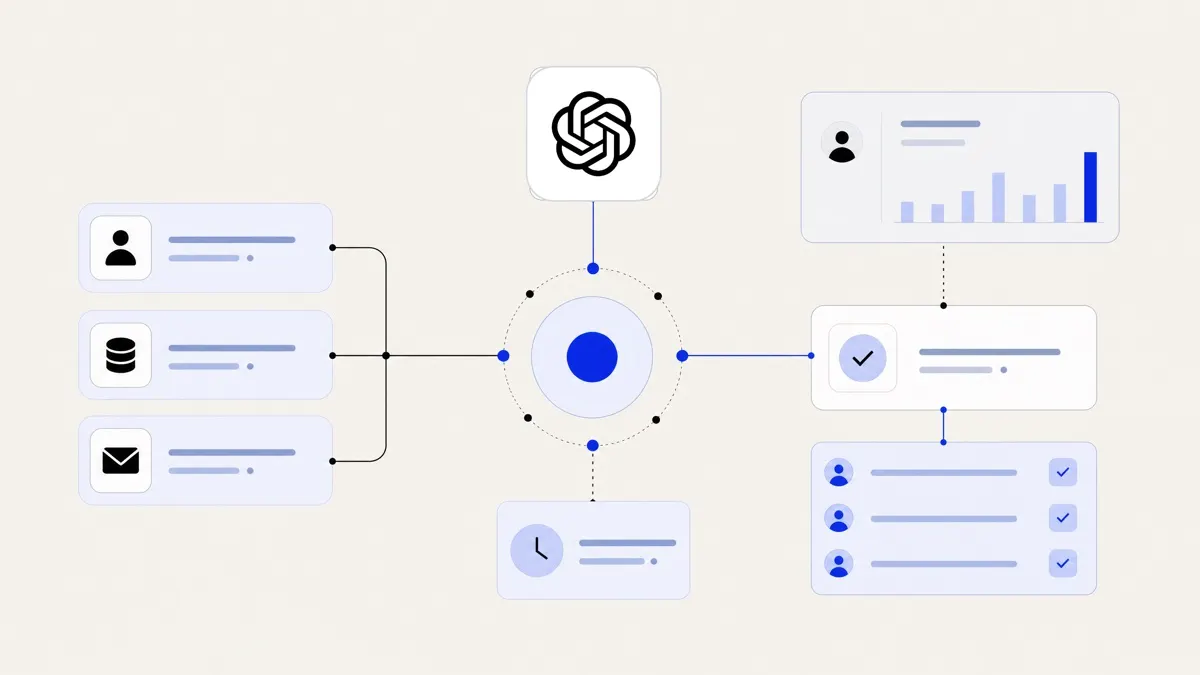
- Trigger – What event starts the process? (e.g., new lead form, incoming email)
- Inputs – What information is needed? (e.g., customer details, order data)
- Decision – What outcome must be decided? (e.g., route to X, reply with Y)
- Outputs – What is produced? (e.g., email, ticket, record update)
If you cannot describe these cleanly, the process may be too fuzzy for early automation. Start with processes that already follow a clear pattern.
3. Measure both cost and experience
To prove competitive advantage, track more than just hours saved. Look at:
- Time from customer request to first meaningful response.
- Number of touches or handoffs per process.
- Error rates or rework in key workflows.
- Customer satisfaction scores or repeat purchase behavior.
If automation reduces internal effort but degrades experience, it is not an advantage. The goal is to improve both where possible, and at least avoid hurting the customer side.
Risks and trade-offs SMEs should understand
AI automation is not free of downsides. A clear view of the trade-offs makes it easier to design around them.
Over-automation and loss of human judgment
Some decisions should remain human-led, especially those involving:
- High financial or legal risk.
- Sensitive customer issues.
- Complex trade-offs with incomplete data.
A practical pattern is “AI does 80%, humans do the last 20%.” Let AI gather, summarize, and suggest, but keep humans as the final approver.
Data quality and privacy
AI systems are only as good as the data and policies behind them:
- Inaccurate or out-of-date data leads to wrong recommendations.
- Unclear data access controls can create privacy and compliance issues.
- Using external AI tools without safeguards can expose confidential information.
SMEs should set simple, explicit rules: what data is allowed in which tools, who can access what, and how long information is retained.
Change management and skills
Even good automation can fail if people do not trust or understand it. Expect:
- Initial skepticism about AI “taking over” jobs.
- Mistakes while new workflows are bedded in.
- The need to update roles and performance measures.
Invest time in training staff to work with AI as a collaborator, not a replacement. Make it clear which tasks are changing and which responsibilities stay firmly human.
A practical roadmap for SMEs to build AI automation advantage
You do not need a grand transformation program. A structured, incremental approach is usually more effective.
Step 1: Map your top 5–10 processes
List the processes that:
- Affect customers directly.
- Tie up your most constrained staff.
- Cause the most delay or rework.
For each, capture the basic flow on one page. This gives you a simple inventory of automation candidates.
Step 2: Prioritize by impact and feasibility
Score each process across two dimensions:
- Impact – Revenue, customer experience, or risk reduction.
- Feasibility – Data availability, clarity of rules, and technical complexity.
Started projects should be “high impact, medium/high feasibility.” Leave low-impact or fuzzy processes for later.
Step 3: Pilot one or two use cases
Run small pilots with clear success criteria, such as:
- Reduce response time for a specific support category by 50%.
- Cut manual data entry for a given document type by 70%.
- Increase quote turnaround speed from two days to four hours.
Keep scope narrow. Aim to learn quickly, not automate everything at once.
Step 4: Standardize, then scale
Once a pilot works reliably:
- Document the new workflow, including human checks.
- Train relevant staff and update job responsibilities.
- Integrate the automation into your main tools and dashboards.
Then replicate the pattern across similar processes, rather than starting from scratch every time.
Step 5: Review your operating model annually
As AI capabilities and your business change, revisit:
- Which processes are now stable and could move from “AI-assisted” to more fully automated.
- Where human expertise is now underused and could shift to higher-value work.
- Whether your cost structure and customer promises should be updated.
Over time, your operating model will lean more on AI for routine execution and more on people for design, relationships, and complex judgment.
For SMEs that want an outside perspective on where to start, talking to an AI automation agency and reviewing structured options like Framworq’s AI automation solutions can help frame which functions are ready and what sequence makes sense.