
AI voice agent vs IVR – what actually changes for your callers
AI voice agents and traditional IVR both answer calls automatically, but they work in very different ways and create very different customer experiences.
On this page
- What is the practical difference between an AI voice agent and IVR?
- How do IVR systems actually work?
- How do AI voice agents work differently?
- AI voice agent vs IVR: key differences that matter to customers
- When should you keep IVR, upgrade, or combine both?
- How to plan a move from IVR to AI voice agents
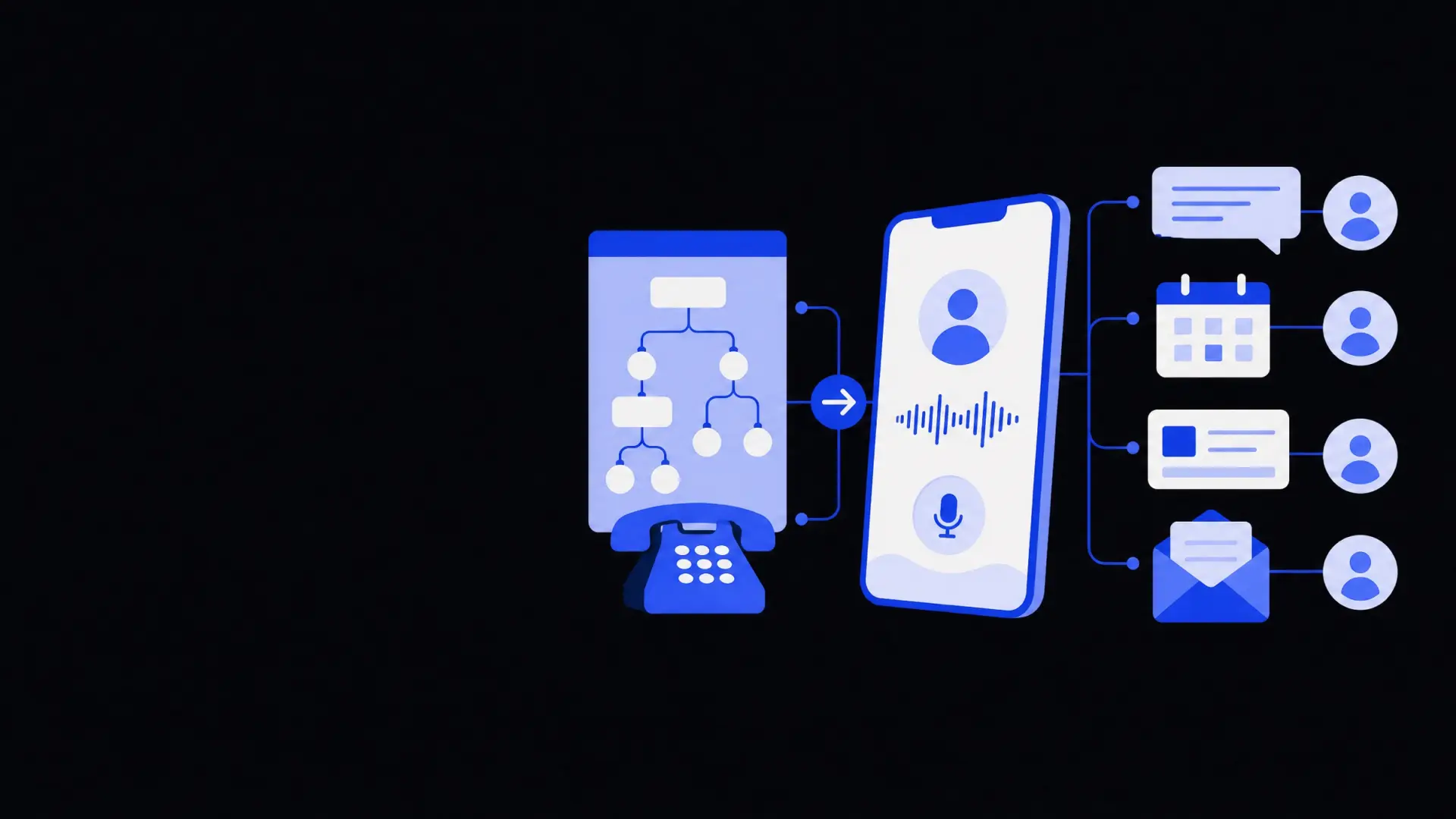
The core difference between an AI voice agent vs IVR is that IVR makes callers follow rigid menus using touch tones or simple phrases, while an AI voice agent can understand natural speech, ask questions, and complete tasks in a flexible conversation. An IVR is a rules-based phone menu; an AI voice agent is a software “employee” that can reason through requests and integrate with your systems in real time.
What is the practical difference between an AI voice agent and IVR?
An IVR (interactive voice response) system is a structured phone menu that routes calls and plays pre‑recorded messages based on keypad inputs or limited voice commands.
An AI voice agent is an automated caller-facing assistant that uses speech recognition, language models, and APIs to understand open-ended requests and take actions in your systems.
In practice, this changes how every call feels:
- With IVR, the caller adapts to the system: “Press 1… press 2… say ‘billing’.”
- With an AI voice agent, the system adapts to the caller: “Tell me what you need, and I’ll handle it.”
Key functional differences:
- Input style
- IVR: DTMF (keypad) and basic speech keywords.
- AI agent: Natural speech, accents, incomplete sentences, and follow-up questions.
- Logic
- IVR: Fixed decision trees configured by admins.
- AI agent: Dynamic reasoning guided by policies and real-time context.
- Actions
- IVR: Route to queues, play audio, capture simple data.
- AI agent: Look up records, update systems, complete workflows, escalate with context.
- Experience
- IVR: Linear and predictable, but often frustrating for complex needs.
- AI agent: Conversational and flexible, but needs good design and guardrails.
Treat IVR as an automated switchboard and an AI voice agent as a trainable frontline employee.
How do IVR systems actually work?
Understanding legacy IVR helps clarify what changes when you move to an AI voice agent.
An IVR is essentially a structured decision tree with audio prompts. It usually sits in front of your PBX or contact center platform.
Typical IVR components:
- Prompt library – Recorded messages like “For support, press 2.”
- Call flow – A tree of menu steps and branches.
- Input capture – Key presses or simple “say 1, say 2” speech capture.
- Routing rules – Map menu choices to queues, extensions, or recorded info.
- Basic data dips – Sometimes a simple check in CRM or ticketing (e.g., account lookup).
What IVR is good at:
- Handling high-level routing (sales vs support vs billing).
- Playing standard information (opening hours, outage announcements).
- Keeping simple requests away from agents when choices are clear and finite.
Where IVR struggles:
- Ambiguous requests – Callers do not always know which menu option applies.
- Long, nested menus – Deep trees lead to frustration and abandonment.
- Context – IVR rarely remembers what a customer said five steps ago.
- Exceptions – Anything unexpected quickly forces “please hold for an agent.”
If your callers often “zero out” to an agent, you are likely hitting IVR’s structural limits, not just a UX problem.
How do AI voice agents work differently?
An AI voice agent adds language understanding and decision-making on top of telephony, so it can handle unstructured requests.
Core building blocks of a modern AI voice agent:
- Speech-to-text (STT)
Converts the caller’s audio into text, ideally with domain-specific tuning and support for different accents and background noise.
- Language understanding and reasoning
A large language model (LLM) or similar system interprets the text, identifies intent, entities (names, numbers, dates), and decides the next best step.
- Business logic and policies
Guardrails that define what the agent can and cannot do, escalation thresholds, security checks, and compliance constraints.
- System integrations
API connections to your CRM, booking tools, payment gateway, ticketing system, or ERP so the agent can:
- Retrieve data (orders, tickets, balances).
- Update data (addresses, notes, appointments).
- Trigger workflows (refunds, reschedules, password reset flows).
- Text-to-speech (TTS)
Converts the agent’s response back into audio with a natural voice, adjusted for speed and tone.
Because the voice agent can interpret intent rather than just menu options, the call flow is more like a dialogue:
- Caller: “I was charged twice last month; I need to fix that.”
- Agent: “I can help. What is the last four digits of the card on the account?”
- Agent (internally): Looks up the account, finds duplicate charge.
- Agent: “I see two identical charges on August 12. I can raise a refund request for one of them. Shall I proceed?”
This is very different from IVR forcing the customer through “billing → payments → disputes → card charges” one menu at a time.
If you want to go deeper into how these agents link with chat, web, and messaging, see our overview of AI chatbots and voice agents.
AI voice agent vs IVR: key differences that matter to customers
From a caller’s perspective, several practical differences stand out.
1. How callers express their needs
- IVR: “For billing, press 3” — the caller must guess the right menu.
- AI voice: “Tell me what you’re calling about” — then it maps the request to billing, support, sales, or a specific workflow.
Outcome: Fewer misroutes and re-explanations, especially for edge cases.
2. Handling multi-part and changing requests
Real calls are messy. Customers often:
- Change their mind mid-call.
- Add “while I’ve got you…” questions.
- Jump back to earlier topics.
- IVR: Designed for a single path per call. Side questions usually mean starting over or transferring.
- AI voice agent: Can treat the conversation as a whole, keep track of context, and handle follow-up questions without restarting.
3. Self-service depth
- IVR: Self-service usually stops at simple lookups and status checks.
- AI voice agent: Can complete tasks end-to-end, such as:
- Rescheduling appointments.
- Updating shipping addresses.
- Adjusting subscriptions within defined rules.
- Creating and categorising support tickets with full summaries.
The more integrated your systems are, the more valuable this becomes. Services like AI voice agent development focus heavily on mapping these deeper workflows safely.
4. Error handling and recovery
- IVR: Mis-press a key or say the wrong word and you may get:
- “Invalid option.”
- A repeat of the entire menu.
- An abrupt transfer.
- AI voice agent: Can clarify:
- “It sounds like you have a question about your last invoice, is that right?”
- “I’m not sure I understood that. Are you asking about delivery, payment, or returns?”
The agent can also rephrase options in simpler language instead of replaying the same prompt.
5. Emotional tone and perceived empathy
Neither system is truly “empathetic,” but tone matters.
- IVR: Fixed voice, fixed phrasing, no awareness of frustration.
- AI voice agent: Can adjust tone (more formal, more casual), acknowledge issues (“I see you’ve called twice about this; let’s try to get it sorted now”), and avoid repeating unnecessary questions.
This does not replace human empathy, but it reduces irritation and makes escalations smoother when they are necessary.
When should you keep IVR, upgrade, or combine both?
You do not have to choose between IVR and AI voice agents in an all-or-nothing way. Many organisations run a hybrid approach.
When IVR alone is usually enough
A traditional IVR can still be a good fit if:
- Your call patterns are simple and predictable.
- Most calls only need basic routing or static information.
- You have strict environments where AI is not yet allowed (some regulated scenarios).
- You do not have accessible APIs for your core systems yet.
In these cases, optimising your existing IVR and shortening menus may be the best near-term move.
Clear signs you are ready for an AI voice agent
An AI voice agent becomes compelling when you see:
- High agent load on repetitive tasks
Agents spend much of their day on:
- Balance checks.
- Order status queries.
- Simple appointment changes.
- FAQ-level support questions.
- Frequent customer frustration with IVR
High rates of:
- Call abandonment in menus.
- “Press 0 to reach an agent” behaviour.
- Complaints about “never getting to the right person.”
- Good digital systems but poor phone integration
Customers can self-serve on your website or app, but must wait for a human on the phone for the same tasks.
- Need for 24/7 coverage without adding headcount
You want after-hours support that does more than just take a message.
If several of these apply, a scoped AI voice project can be lower risk than trying to “fix” IVR alone. A focused engagement such as AI agent development typically starts with a few high-impact call types instead of everything at once.
Hybrid setup: using both IVR and AI voice agents
A common modern pattern:
- IVR handles the very first layer:
- Language choice.
- High-level routing (sales / support / billing).
- Emergency or outage announcements.
- Within each area, an AI voice agent:
- Greets the caller in natural language.
- Handles the majority of self-service tasks.
- Escalates to humans with a concise summary when needed.
This limits the complexity of the AI implementation while giving callers a significantly better experience where it matters most.
How to plan a move from IVR to AI voice agents
A structured approach reduces risk and avoids disrupting your existing operations.
- Map your top call types
List the 5–10 most common reasons people call, in plain language:
- “Where is my order?”
- “I need to change my appointment.”
- “My invoice is wrong.”
Prioritise the ones that are frequent, repetitive, and well-defined.
- Identify required system access
For each call type, note:
- Which system holds the data (CRM, ERP, booking, billing).
- What actions you would allow an automated agent to take (read-only vs update vs trigger workflows).
This clarifies which API integrations or workflow changes may be necessary.
- Define guardrails and escalation rules
Write down:
- Cases where the AI must always transfer to a human (e.g., complex disputes).
- Maximum call duration before escalation.
- Sensitive data the agent may not read aloud or modify.
- Start with a narrow pilot
Begin with one or two clear use cases, for example:
- Order tracking.
- Appointment management.
- Password reset support (without handling the password itself).
Restrict the pilot to certain lines or hours if needed.
- Measure outcomes against IVR baselines
Compare:
- Containment rate (issues solved without human agents).
- Average handle time for calls that still reach agents.
- Customer feedback on call experience.
Use this to decide whether to expand, adjust, or pause rollout.
- Iterate on conversation design
AI voice agents learn quickly from real calls, but they also need human oversight.
- Review call transcripts regularly.
- Adjust prompts and safeguards.
- Expand or tighten actions based on observed behaviour.
Over time, you can keep IVR for simple routing and announcements, and let AI voice agents handle the conversations that actually require understanding and action.
In summary, IVR is a phone menu that guides callers through fixed choices, while an AI voice agent is a conversational system that can understand intent, access your data, and complete tasks. The best approach for most organisations is not to throw IVR away overnight, but to gradually introduce AI voice where it clearly improves caller experience and reduces repetitive workload on your teams.
Where Framworq can help
Want this mapped for your business?
We’ll help you find the highest-leverage workflows to automate first — and build them end to end. No jargon, no lock-in.
Book a free automation audit