
Using ElevenLabs AI voice for natural, branded customer calls
Learn how ElevenLabs AI voice can power natural, branded voice agents for customer calls, and what it takes to design, integrate, and govern them well.
On this page
- What is ElevenLabs AI voice and where does it fit in the stack?
- Why use ElevenLabs AI voice for customer calls?
- Designing a branded, human‑sounding AI voice persona
- How to integrate ElevenLabs AI voice into your call flows
- Use cases where ElevenLabs voice agents work well
- Governance, testing, and measuring impact
ElevenLabs AI voice can be used to create natural, branded voice agents that handle customer calls end‑to‑end, from greeting to resolution, by combining realistic text‑to‑speech with a conversation engine, telephony integration, and workflow automation. To make this work in practice, you need to design a clear voice persona, connect ElevenLabs to your phone system, orchestrate AI logic for call flows, and put guardrails, monitoring, and handoff rules in place.
What is ElevenLabs AI voice and where does it fit in the stack?
ElevenLabs AI voice is a text‑to‑speech and voice cloning platform that converts written responses into natural‑sounding speech, and can generate custom voices that match a brand’s tone. On its own, it does not handle call logic, understand callers, or integrate with CRMs — it is one component in a broader voice agent stack.
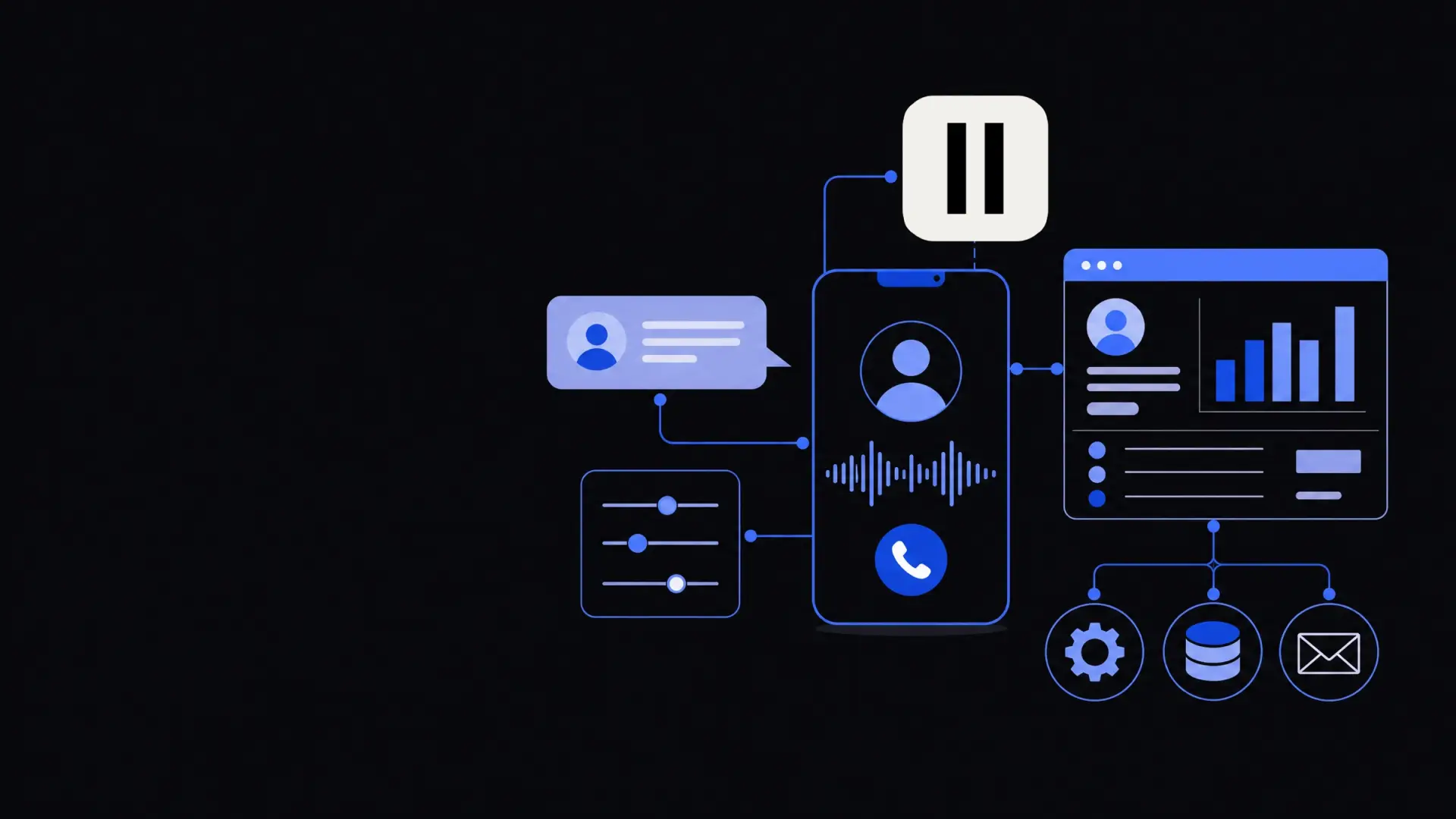
In a typical production setup, ElevenLabs sits in the middle of four layers:
- Telephony layer – Your phone numbers, SIP trunks, or cloud calling provider that connects to customers.
- Speech interface – A speech‑to‑text engine that turns audio into text, and ElevenLabs text‑to‑speech that turns responses back into audio.
- Conversation engine – A large language model and dialogue manager that decide what the agent should say and do next.
- Business integrations – APIs and automations that connect to CRMs, ticketing tools, payment systems, and internal databases.
Framworq usually implements this as part of a broader AI chatbots and voice agents solution, where ElevenLabs is chosen as the voice output component for its naturalness and branding flexibility.
Why use ElevenLabs AI voice for customer calls?
Using ElevenLabs for customer calls is mainly about three things: brand consistency, caller comfort, and operational efficiency.
1. Branded, consistent voice
A custom AI voice becomes part of your brand identity. Unlike rotating human agents, an AI agent:
- Sounds the same on every call and channel.
- Keeps tone, pacing, and diction aligned with brand guidelines.
- Can be cloned from a professional voice actor to match your chosen persona.
This consistency makes it easier to train customers what to expect from your automated experiences.
2. More human, less “robotic”
Legacy IVR systems sound flat, rushed, and scripted. ElevenLabs offers:
- Natural prosody and intonation, closer to human speech.
- Pauses and emphasis that help callers follow complex information.
- Multiple emotional styles, from warm and empathetic to concise and business‑like.
That improves perceived quality, even when the underlying logic is similar to older IVR flows.
3. Extended coverage and lower marginal costs
Once the voice agent is designed and deployed, it can:
- Handle long hours or 24×7 coverage without extra staffing.
- Scale up to large call volumes during spikes.
- Handle repetitive queries and processes, freeing humans for complex or relationship‑heavy work.
The trade‑off is that you now run a piece of software infrastructure, not just a script. That means you must invest in monitoring, updates, and data governance.
The voice quality of a customer call is rarely the problem — it is the call flow design, integrations, and guardrails that determine real‑world performance.
Designing a branded, human‑sounding AI voice persona
A strong AI voice experience starts with a well‑defined persona. This is not only about how the voice sounds, but also how it behaves in conversation.
1. Define the voice profile
Clarify the following attributes before recording or choosing a voice:
- Accent and language coverage – Which regions and languages do you serve? A neutral accent may be better for global calls, while a regional accent may help local trust.
- Age and gender presentation – Choose what best aligns with your brand and customers; test it with real users.
- Tone and pacing – Decide if the voice should be warm and conversational, precise and formal, or somewhere in between.
- Energy level – High‑energy voices can feel helpful for support, but may feel pushy in collections or compliance‑sensitive contexts.
With ElevenLabs, you can either select an existing voice or train a custom one from approved recordings.
2. Write a behavioral style guide
The conversation engine needs a style guide in plain language. Document:
- How the agent should greet, address, and close calls.
- Phrases to prefer (e.g., “Let me check that for you”) and phrases to avoid.
- How to respond to confusion, frustration, or silence.
- The level of detail and length allowed in explanations.
This guide is then translated into system prompts and policies inside your AI voice agent development stack.
3. Set boundaries and escalation rules
Voice naturalness can create unrealistic expectations if there are no boundaries. Define:
- Topics the agent is allowed to handle autonomously.
- Triggers for escalation — e.g., repeated “I don’t understand,” mentions of legal issues, or high‑value accounts.
- Hard rules for sensitive actions such as payments, cancellations, or personal data changes.
The ElevenLabs voice will make the agent sound human, but safety comes from these rules, not the voice itself.
How to integrate ElevenLabs AI voice into your call flows
To use ElevenLabs in production calls, you need to connect it into a live audio pipeline and your business logic.
1. Choose your telephony and audio routing
Decide where call audio will be captured and routed. Common patterns:
- Cloud telephony provider (e.g., Twilio, Vonage) that exposes media streams in real time.
- SIP trunking connected to your PBX with a media gateway that forwards audio to your AI service.
- Embedded calling in web or mobile apps, where the client sends and receives audio via WebRTC.
From there, the incoming audio is sent to your speech‑to‑text engine, while the outgoing text from your conversation engine is passed to ElevenLabs for synthesis.
2. Connect speech‑to‑text and ElevenLabs
Most production systems use one vendor for recognition and another for synthesis. Key steps:
- Stream caller audio to a speech‑to‑text API and receive partial transcripts.
- Pass those transcripts to your conversation engine for intent detection and response generation.
- Send the response text to ElevenLabs, choosing the appropriate model, voice, and style parameters.
- Stream the generated audio back to the caller with minimal latency.
This requires non‑trivial real‑time engineering. Many teams handle this via a custom middleware service or an AI orchestration layer developed as part of broader AI agent development.
3. Orchestrate the conversation logic
The voice agent should follow clear call flows, not just answer each utterance in isolation. For customer calls, this typically means:
- Starting with authentication or context (e.g., looking up the caller’s phone number).
- Routing into specific flows such as billing, appointments, orders, or account changes.
- Maintaining memory across turns in a conversation state store.
- Logging key events to your CRM or ticketing system after each call.
Modern setups use large language models to generate responses but keep a rule‑based skeleton for required steps, disclosures, and validations.
Use cases where ElevenLabs voice agents work well
Not every call type is suitable for an AI agent, even with a high‑quality voice. The best matches have clear intent patterns and structured outcomes.
1. Front‑line triage and routing
For many businesses, the first 30–60 seconds of a call are about figuring out who the caller is and what they want. ElevenLabs‑powered agents can:
- Greet callers in a friendly, branded voice.
- Ask open but guided questions (“In a few words, how can I help today?”).
- Map responses to specific queues or automated flows.
- Capture structured metadata for human agents before handoff.
This reduces average handle time for human staff and helps them start with context.
2. Routine self‑service tasks
Voice agents are particularly effective for:
- Checking order, shipment, or appointment status.
- Updating contact details or preferences under defined rules.
- Rescheduling appointments within available slots.
- Providing simple product or policy information.
Here, the ElevenLabs voice mainly improves the experience versus traditional IVR menus.
3. After‑hours support and overflow
During off‑hours or peak loads, a natural‑sounding AI voice can:
- Provide status updates and troubleshooting steps.
- Capture details for a next‑day human follow‑up.
- Escalate to on‑call staff only when clear criteria are met.
This works well when combined with wider AI chatbots and voice agents deployed across web, chat, and phone to keep answers consistent.
Governance, testing, and measuring impact
A good deployment plan treats voice agents as an evolving service, not a one‑off project.
1. Testing before full rollout
Before you put an ElevenLabs voice agent on your main numbers:
- Run internal “dogfooding” with staff using real‑world scenarios.
- Test edge cases such as noisy environments, interruptions, and heavy accents.
- Compare responses against your compliance and brand guidelines.
Use call replays and transcripts to refine prompts, flows, and voice settings.
2. Monitoring live performance
After launch, monitor both quantitative and qualitative metrics:
- Containment rate — calls fully resolved by the AI agent.
- Escalation rate and reasons — why calls are handed to humans.
- Average handling time and queue times before and after deployment.
- Customer satisfaction from post‑call surveys and sampled call reviews.
Regular reviews should feed into updates of the voice persona, style prompts, and flows.
3. Data, privacy, and consent
Because you are processing voice — often with personal data — ensure you:
- Inform callers when an AI agent is handling or assisting the call.
- Store recordings and transcripts according to your retention policies.
- Mask or avoid storing sensitive fields such as card numbers, where required.
- Align with your sector’s regulations, especially in finance, healthcare, or government contexts.
For regulated industries, combining ElevenLabs with a well‑designed automation architecture and appropriate controls from business process automation services is often necessary.
Using ElevenLabs AI voice for customer calls works best when you treat the voice as one carefully tuned component in a larger system that handles understanding, decisions, and integrations. With a clear persona, robust call flows, responsible governance, and ongoing optimization, you can offer callers a natural, branded experience that complements — rather than replaces — your human team.
Where Framworq can help
Want this mapped for your business?
We’ll help you find the highest-leverage workflows to automate first — and build them end to end. No jargon, no lock-in.
Book a free automation audit